This is a long shot of the surroundings in which the video is based, which is Brazil. This is the typical thing that we expect from a Snoop Dogg video, a warm setting with a beach and hot climate.
This is a long shot of a beach that is in the video with pretty or 'hot' girls which are also typically seen as something Snoop Dogg includes in his videos.
This is a close up of Snoop Dogg smoking some sort of drug. This is the type of thing that is seen to be in a Snoop Dogg video.
Rihanna - Dancing, dark environment, males involved narrative shows the relationship.
This is a close up of Rihanna and a male actor, this is the kind of thing that is typically seen in one of her videos.
This is a long shot of Rihanna in a room with a dark sort of setting is the sort of thing that she uses to tell the story of her songs, going from a dark place to a nice one.
This is a long shot of a part in the video that looks like it is telling the relationship between the two characters. This is the type of thing that is normally used in her videos.
This is a mid shot from the video. It shows the pale make up of the actors. This is the typical thing that is seen in this bands videos.
This is a mid shot of the main singer in the band in an olden sort of house setting. This is also the type of thing you find in their videos.
This is a long shot of all of the actors in the video. You can see all of their over the top costumes and make up. These are also the types of things you find in the bands videos.
Yorke has suggested that the song was inspired by the 1991 novel The Famished Road, written by Ben Okri, and that its music was inspired byR.E.M.The track is built around a soft melody in A minor with an arpeggio (broken chord) guitar part. A previous, working title for the song was "Three Headed Street Spirit", as seen in interviews with Thom Yorke preceding the release of The Bends. The single is also acclaimed for the quality of its B-sides; for example, "Talk Show Host" rose to prominence after it was remixed by Nellee Hooper for the 1996 film Romeo + Juliet, since becoming a regular at Radiohead concerts.
Mise en scene
Lighting - There is no lighting as it is in black and white. Location - Filmed during two nights in a desert just outside Los Angeles. Costume - The main band where normal everyday clothing. The other characters in the video wear either black clothing or regular clothing. Make up - The make up is simple and not obvious. Actors - There are the band, some dancers and some extras.
Narrative
All of our saddest songs have somewhere in them at least a glimmer of resolve. Street Spirit has no resolve. It is the dark tunnel without the light at the end. It represents all tragic emotion that is so hurtful that the sound of that melody is its only definition. We all have a way of dealing with that song. It’s called detachment. That’s why its lyrics are just a bunch of mini-stories or visual images as opposed to a cohesive explanation of its meaning. I used images set to the music that I thought would convey the emotional entirety of the lyric and music working together. That’s what’s meant by ‘all these things you’ll one day swallow whole’. I meant the emotional entirety, because I didn’t have it in me to articulate the emotion.This song is actually the blueprint of life compacted into three short paragraphs. They basically state how it doesn't matter where we're going in life; we just need to "love" what we're doing. People spend too much of their time pondering the meaning of life instead of actually living. Some people even blindly do what seems socially encouraged and become part of "the system".
Camera In this video there are mainly long shots and close ups used in it. It is more the long shots are to see what is happening and the close ups are to see the reactions or important things that are going on.
This is a long shot of one of the dancers in the video. This shot is so simple but through the dancer it tells you a story and as she is dressed in black you can interpret that it is sad.
This again is another long shot of dancers but this time it is a three shot rather than just a single one.
This is a close up of the main band memebers face as he sings. It shows you his reaction to the words that he is saying.
This is an extreme close up of a chain that a dog is on. It could represent that a person feels like they are on a chain and that they want to break free. This is a long shot of the main band memeber smashing some glass. it is interesting as it could mean that he is fiunally breaking out of something.
Editing
The editing uses mainly one type which is fade but it is a diswsolving fade between each scene. In the video there are alot of slow motion shot within it, it is like time is slowing down but it also gives you a chance to absorb what the video is trying to tell you.
Sound
The track has a simple beat. The lyrics are the thing that run the video as they are both linked together. Even though it is a four minute video it only has a few lyrics. Here are the lyrics: Rows of houses, all bearing down on me I can feel their blue hands touching me All these things into position All these things we'll one day swallow whole And fade out again and fade out
This machine will, will not communicate These thoughts and the strain I am under Be a world child, form a circle Before we all go under And fade out again and fade out again
Cracked eggs, dead birds Scream as they fight for life I can feel death, can see its beady eyes All these things into position All these things we'll one day swallow whole And fade out again and fade out again
Immerse your soul in love IMMERSE YOUR SOUL IN LOVE
Lighting – At the
start of the video there is the man in a dark room but he is lit by one light
so you can clearly see him and everything that he is doing. The rest of the
video looks like it is lit naturally until they get to the mine and it is dark
apart from light that is streaming in from behind the statue.
Location – The
video starts in an apartment then goes out into the streets as the boy runs the
location changes and it keeps changing as it is like they are going on a
journey. The video is actually filmed in Bolivia.
Props – At the
start of the video there are props like a bottle of alcohol and eggs then there
were things like a boom box and a heart. These are all important props as it
helps tell the story for example the bottle of alcohol helps the audience see
why the man is angry so they can see it’s an abusive home. Then things like the
heart are important as the video is like a version of the wizard of Oz so the
man with the kid at this point is like the tin man who wants a heart.
Costume – The costume
is different for each actor. The kid has simple childlike clothing whereas the
tin man has grey coloured clothes so he looks more tin or robotic like to go
with the way he moves. The other actor with the boy is supposed to be the
scarecrow man he has wool like clothing on with a mask to cover his face which
is in the shape of an elephant.
Make up – The man
in the gym who looks like he is playing the tin man has silver make up on to
make him look tin coloured which matches his clothing. The women also in the
same scene has dripping make up to show that they are working hard.
Actors – Boy who is
the main character. The dog who is supposed to be both Toto and the lion. The
silver looking man who is supposed to be the tin man and the scarecrow. As well
as a few brief characters like the father, the man who sells them a heart and
the women in the gym.
Narrative
This music video is
based on the Bolivian legend from the 19th century about a deaf boy who left an
abusive home who found a stray dog and discovered a talent of percepting people
troubles while living on the streets. It was said he fixed the problems by
screaming which was said to be so loud as an earthquake. He finds an old man
who is in trouble and helps him out and receives a heart somehow which is shown
in the video as the boy buying him one. He finds another man who is disfigured
and he tells the boy about the demon El Tio was cursed him. El Tio is
considered as the lord of the underworld which people offer gifts to be
protected by him or to ease his angry and that anyone who could hear him would
fall under his control. He was said to be found in the desert. The boy goes
into the mine where the demon was said to be as he was deaf he couldn't hear
the demon but he could scream to stop him from cursing others. The video is a
version of the wizard of Oz to conceal the legend to those who don't know it.
Camera
This shot is a long wide shot of the starting scene. It includes the father character sat in a dark room with a single light that is on him. It is framed in the door way.
This is a wide long shot. It shows everything in the room which is important in the story of the video. You can see the alcohol and the aggressive posture of the father character which makes the audience think that something is going to happen.
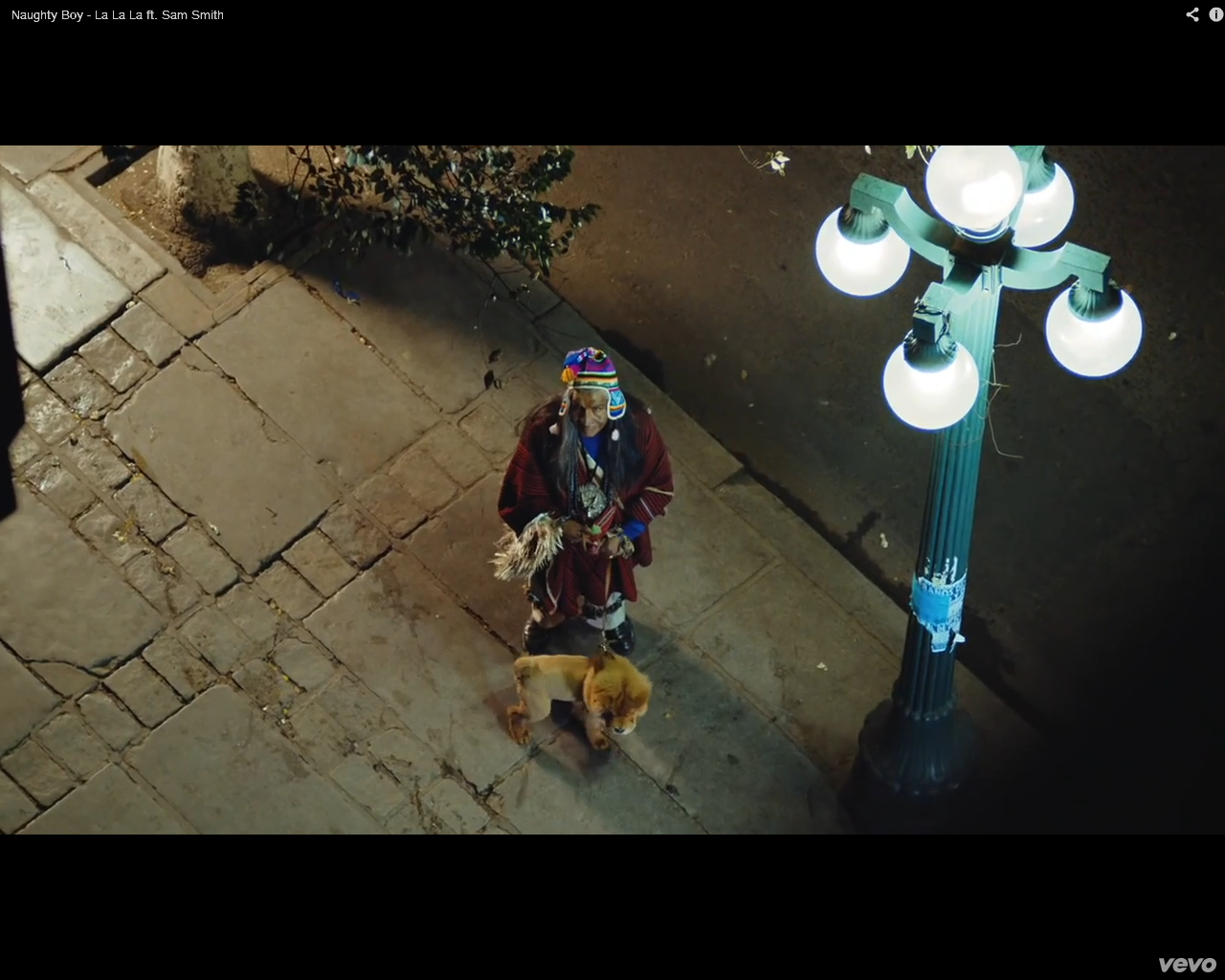
This is a high to low shot looking down from the boys point of view to a man with a dog.
This is a tracking shot of the boy and the dog running. The camera is focused on the dog and the boys feet but also the ground. It is paved like a brick road like the yellow brick road in the wizard of Oz it is like they are going on a journey.
This is like the shot above but you can tell both the location and the time has changed so it is showing the boy is on a journey. This is a low tracking shot, close up of the boys feet and of the dog.
This is a close up of the tin man character getting a heart, which is apart of the wizard of Oz story but also apart of the Bolivian legend that this video is also based on.
This is a close up of the scarecrow character. It clearly shows how different he is from others and also the costume.
This is a long shot. As you can see it is a shot of a road which also shows the journey but this time for all of them.
This is a mid shot of all of the characters. It shows the connection between them.
This shot is a long shot showing the location but also how the train tracks represent the yellow brick road. It also shows the small TV which has something on the screen.
This is a close up of the boys face. It shows his reaction to the fact that he has come to the end of his journey.
This shot is back tracking close up to long shot of the boy and a statue of 'El Tio' from the Bolivian legend. Editing
At start there is a
fade in from black to give the sense that the video is playing but also like
someone is walking down a dark hall. To cut between each shot straight cuts are
used, they are very effective and short so that we can see the story that the
video is trying to tell.
Sound
The track has a very simple beat which is catchy. The lyrics are simple and effective in telling the story. Here are the lyrics: Hush, don't speak When you spit your venom, keep it shut I hate it When you hiss and preach About your new messiah 'cause your theories catch fire
I can't find those silver linings I don't mean to judge But when you read your speech, it's tiring Enough is enough
I'm covering my ears like a kid When your words mean nothing, I go la la la I'm turning off the volume when you speak Cause if my heart can't stop it, I find a way to block it I go La la, la la la... La la, la la la... I find a way to block it I go La la, la la la... La la, la la la...
Yes our love is running out of time I won't count the hours, rather be a coward When our words collide I'm gonna drown you out before I lose my mind
I can't find those silver linings I don't mean to judge But when you read your speech, it's tiring Enough is enough
I'm covering my ears like a kid When your words mean nothing, I go la la la I'm turning off the volume when you speak Cause if my heart can't stop it, I find a way to block it I go La la la la la... La la la la la... I find a way to block it I go La la la la la... La la la la la... I find a way to block you, oh La la la la la... La la la la la... I find a way to block it I go La la la la la... La la la la la...
I'm covering my ears like a kid When your words mean nothing, I go la la la I'm turning off the volume when you speak Cause if my heart can't stop it, I find a way to block it I go
I'm covering my ears like a kid when your words mean nothing, I go la la la I'm turning off the volume when you speak Cause if my heart can't stop it, I find a way to block it I go La la la la la... La la la la la... La la la la la... La la la la la...
The video above is of REM's song 'Bad Day'. This video has references to news channels such as The O'Reilly Factor etc.
In the video, Stipe appears as the Morning Team's news anchor Cliff Harris; Mills doubles as roving reporter Ed Colbert and meteorologist Rick Jennings; and Buck as climate expert Geoff Sayers and the reporter Eric Nelson. News stories shown include a monsoon contained within an apartment, a senator's office flooding, and a tornado inside a boy's bedroom.
Above are screen shots from the music promo. You can see how they linked their video to the news from the way they looked to the props they use and even the small scrolling titles at the bottom of the screen.
It is a powerful political
critique of politicians and the media reporting on them and topics of the day.
That is, it is not just about someone having a bad day. The main thing I wanted
to add was the whole bit about "please don't take a picture." To me
that has always been a funny tongue-in-cheek reference to political scandals
and ethical / legal issues, where the white collar criminal always looks so
stupid trying to hide their faces.
The first verse is about the media
being jerking with stories that aren't independent, but somehow too politically
biased, either telling "thick shit" about those they don't favour, or
portraying others as "whitewashed" and non-stick ("Teflon")
clean. And all this to a degree where we just "pay it never mind".
The second verse, I think, is about
politicians acting crazy for the media, but if you "look behind the
eyes" you see that they really mean to "save my own ass, screw these
guys".
In the last two verses it gets more serious. I
think the third verse is about oil. "We dug in deep" (for oil?)
"The price is steep" (oil prices are raising fast?), and I have can
easily follow that the oil traders can be some creeps. "The lights went
out, the oil ran dry": America is very (too) dependent on oil, when
there's no oil everything stops. All this we "blame on the other
guy", who else but the favourite scapegoat of the 21th century: the Arabic
world/the middle east, which ties perfectly to the next verse: "sure we're
all equal", but this is "THE church" saying nearly like Orwell
puts it in Animal Farm, that some people (in this case the Christians) are more
equal than other (in this case the Muslims). I think "ashes to ashes, we
all fall down" is a way of saying that neither part will benefit from this
growing tension, and if we don't "ignore the lower fear" (deep fear?
- fear of the unknown/strange? - religions (being the ones
"explaining" all the big questions we will never know the answers
to) then "this means war". These are the lyric to the video:
"Bad Day"
A Public service announcement
followed me home the other day
I paid it never mind. Go away.
Shits so thick you could stir it
with a stick- free Teflon whitewashed presidency
We're sick of being jerked around
Wear that on your sleeve
Broadcast me a joyful noise unto
the times, lord,
Count your blessings.
We're sick of being jerked around
We all fall down.
Have you ever seen the televised
St. vitus subcommittee prize
Intertextuality is the shaping of a text meaning by another text. Intertextual figures include: allusion, quotation, calque, plagiarism, translation, pastiche and parody.[1][2][3] An example of intertextuality is an author’s borrowing and transformation of a prior text or to a reader’s referencing of one text in reading another.
The term “intertextuality” has, itself, been borrowed and transformed many times since it was coined by poststructuralist Julia Kristeva in 1966. As critic William Irwin says, the term “has come to have almost as many meanings as users, from those faithful to Kristeva’s original vision to those who simply use it as a stylish way of talking about allusion and influence.”
Though the cassette tape cartridge is invented for transcription purposes in
1930, the cassette is slow to enter the recorded music industry as a viable
format. The cassette tape takes a major step toward becoming mainstream in 1944,
when Signal Corps Captain John Mullin sends two working tape recorders recovered
from Radio Frankfurt in Germany to the U.S. German inventors also had developed
tapes with 20 minutes of recording time.
Adopting and building on the German technology, American inventors introduce
the first portable audiotape recorders in 1951. In 1958, RCA offers cassette
tapes for $1 more than the vinyl album. But it isn't until 1964 that the
cassette has its commercial breakthrough, when Philips introduces its own
30-minute format for the tape cartridge and allows other manufacturers to
duplicate the specifications. This standardization of cassette tapes creates a
market for an inexpensive and portable solution to reel-to-reel tape. With the
price of a blank tape around $3 and a vinyl album at $6 by the end of the 1960s,
the record companies start to worry about the recordable cassette affecting
their sales.
This is th type of development in technology linked to the way bands and singers developed.
The video above is of the Rolling Stones song 'paint it, black' released in 1966. The song was written by Mick Jagger and Keith Richards. Mick Jagger wrote the lyrics and Keith Richards wrote the music. The single reached number one in both the United States and the United Kingdom charts in 1966. In 2004 it was ranked number 176 on Rolling Stonemagazine's list of the 500 Greatest Songs of All Time. In the US and UK, it was the first number one single to feature a sitar. It is a simple video containing many close up of the main singer and some of the band as well as some mid and long shots of the audience dancing to the band.
The video above is of the 1969 The Jackson 5's song 'i want you back'. It went to number one on the soul singles chart for four weeks and held the number-one position on the Billboard Hot 100 singles chart for the week ending January 31, 1970. "I Want You Back" was ranked 121st on Rolling Stone's list of The 500 Greatest Songs of All Time. The video again is very simple as it mainly shows the band. Even though it is simple it is very effective as you focus on the band and the music more than anything else. 1970's In this time things like the Atari Video Music was released in 1976 and was an analog video synthesizer that could generate a kaleidoscopic light show on your TV screen when hooked up to your stereo. Also the U.S. Congress declares sound recordings worthy of copyright protection in
passing the 1971 Sound Recording Amendment to the 1909 Copyright Statute. Though
this amendment is proposed largely in response to the record industry's
complaints of vinyl bootlegging, the implications of the amendment are applied
to the burgeoning recordable cassette market. Record executives complain that
teenagers tape and swap their favorite albums, and advocate a tax on blank
cassettes to make up for the lost revenue from tape trading. With music sales
still growing, the objections to taping are largely unheard.
By the late 1970s, music sales slide, and the record companies begin an
industry-wide campaign to curb home taping. But cassettes hit the big time with
the decline of 8-track players and the introduction of the Sony Walkman in 1979.
The Walkman revolution coincides with improvement in cassette sound quality and
the cassette tape suddenly became the only format that you could have in your
home, in your car, and in your pocket. The Recording Industry Association of
America (RIAA), the record industry's lobbying and trade organization, continues
its fight for taxes on blank tapes into the 1980s and legislators eventually
grant the music labels a portion of every blank tape sale.
This development also affected what the bands and singers of this time had to do to become succefull.
The video above is the 1977 Sex Pistols song 'God save the queen'. The song was released duringQueen Elizabeth II'sSilver Jubileein 1977. The record's lyrics, as well as the cover, were controversial at the time, and both theBBCand theIndependent Broadcasting Authorityrefused to play the song. The song reached number one on theNMEcharts in theUnited Kingdom, but only made it to number two on the officialUK Singles Chartas used by the BBC. This led to accusations by some that the charts had been "fixed" to prevent the song from reaching number one. The video has shots of the band but also of other things as well like shots of the police and people walking around with burning letters on poles like a sort of protest. You can clearly see how the music video has changed from the simple 1960's videos to the ones like this one. The video above is of the 1975 ABBA song 'Mamma Mia'. Recorded by the Swedish pop groupABBA, written byBenny Andersson,Björn UlvaeusandStig Anderson, with the lead vocals shared byAgnetha FältskogandAnni-Frid Lyngstad. It is the opening track on the group's third album, the self titledABBA. The song's name is derived from Italian, where it is aninterjectionused in situations of surprise or anguish (literally, "My mother"). The song is about a woman who is time and time again disappointed by her unfaithful partner, but forgives him anyway. The video is still simple but has more shots making it different from other music videos. 1980's Philips and Sony announce plans to work together to come up with a uniform
standard for a Compact Disc (CD) in 1978. In 1982, record companies announce a
worldwide standard that ensures that all CDs will play on all CD players. Billy
Joel's 52nd Street, released in 1982 in Japan, becomes the first CD
released in the world. By 1988, the CD surpasses the LP in sales.
With the introduction of the CD, the '80s become the most explosive boom
period in recorded audio history, as consumers replace their vinyl collections.
Within three years of the CD's arrival in the marketplace, the electronics
industry sells one million CD players. By contrast, it took 11 years for color
television manufacturers to sell one million units. The video above is of the 1984 Wham song 'Wake me up before you go go'. It was their first UK number one hit. It was written and produced by George Michael, one half of the duo. This song also appeared in soundtrack for the movie Zoolander. The video is mainly of the band which are shown with lots of different types of shots making it more interesting. It also includes other people within the video so it makes it not just about the band but the effect it and this particular song has on others. The video above is of the 1984 Madonna song 'Like a virgin'. It was written by Billy Steinberg and Tom Kelly and produced by Nile Rodgers; Steinberg said that the song was inspired by his personal experiences of romance. The lyrics of the song are ambiguous and consist of hidden innuendo. In sexual terms, the lyrics can be interpreted in different ways for different people. "Like a Virgin" received positive reviews from contemporary as well as old critics, who frequently called it as one of the defining songs for Madonna. It became her first number-one single on the Billboard Hot 100, while reaching the top of the charts in Australia, Canada and Japan and the top-ten of the other countries. The video tells a story using different locations, people etc. It is very different from earlier music videos as it doesn't just show the song but the story behind it. 1990's
The combination of digital audio and the Internet create a combustible
phenomenon upon the invention of the Moving Picture Experts Group-1, Layer-3
(MP3) in 1990. The MP3 compresses digital audio files by a factor of 12 to a
size that can be easily sent from computer to computer without compromising
quality.
The video above is of the 1992 Take That song 'A million love songs'. It was written by lead vocalist Gary Barlow. It was released in the United Kingdom on 5 October 1992 and peaked at number 7 on the UK Singles Chart. Again the video is very simple but this time you can tell it is more modernized. The black and white theme and the live saxophone and piano give it a sort of atmosphere. The video above is of the 1997 Spice girls song 'Spice up your life'. It was written by the group members, with Matt Rowe and Richard Stannard, at the same time as the group was filming scenes for their movie Spice World. The song was produced by Rowe and Stannard for the group's second album Spiceworld, released in November 1997. "Spice Up Your Life" is a dance-pop song with influences of Latin rhythms such as salsa and samba. The lyrics are inspired by Bollywood films and reflects the group desire to "write a song for the world". The music video, directed by Marcus Nispel, features the Spice Girls in a futuristic setting, inspired by the 1982 film Blade Runner, controlling every aspect of society in a dark futuristic cityscape. The group promoted the song heavily, performing it on many television programmes and award shows. Released as the album's lead single in October 1997, it topped theUK Singles Chart on 19 October 1997 for one week, becoming the group's fifth consecutive chart-topper. This made the Spice Girls the first act to have its first five singles reach number one in the United Kingdom. It performed almost as well internationally, peaking inside the top five on the majority of the charts that it entered. In the United States, the song did not perform as well as their previous releases, peaking at number eighteen on the Billboard Hot 100, and barely cracking the magazine's component charts.The video is has a futuristic theme. The video shows a type of story and includes them and others in a future like theme. 2000's In 2003, Apple Computer launches the most successful online music store to
date. In its first year, Apple sells 70 million songs at $0.99 per song,
creating nearly $70 million in legal Internet music sales. Questions remain as
to how the new market for legal downloading will affect the sales of physical
CDs and whether it will redefine the basic unit of music consumption.
The video above is of the 2005 Fall Out Boy song 'Sugar, we're going down'. With the music composed by lead vocalist and guitarist Patrick Stump and all lyrics penned by bassist Pete Wentz, the single reached No. 8 on the US Billboard Hot 100, becoming Fall Out Boy's first top 10 hit and exploding the band into the mainstream, exposing them to a new audience. It spent five weeks in the top 10 and 20 weeks in the top 20 out of its 42 chart weeks before it was retired. The video is like the band is telling a boys story of how is is treated different by everyone as he is different, but how a girl likes him in the end. The video consists of a small cast of people as well as the band. The band are shown with mainly close ups, mid shots and some tracking as they play their instruments where as when the shots of the story line are shown they are more like ones you would see in films. The video above is of the 2012 Lawson song 'Standing in the dark'. Third single by British pop rock band Lawson, from their debut studio album, Chapman Square. The song was released in the United Kingdom on 14 October 2012, via Polydor Records. The song first premiered on BBC Radio 1 on 1 September. The video features band member Andy performing the track in his flat, while the rest of the band perform in a deserted car park, in the pouring rain. It is a typical love song about a guy losing a girl. It uses typical shots like close ups and mid shots so you can see the location and the band as they sing and play the song. As you can see above from the 1960's to the 2000's the typical music video have changed majorly as they have become more modern as time has gone on. This is so the music appeals to the audience making them want to buy the song.
 This is a long shot of the surroundings in which the video is based, which is Brazil. This is the typical thing that we expect from a Snoop Dogg video, a warm setting with a beach and hot climate.
  This is a long shot of a beach that is in the video with pretty or 'hot' girls which are also typically seen as something Snoop Dogg includes in his videos.
  This is a close up of Snoop Dogg smoking some sort of drug. This is the type of thing that is seen to be in a Snoop Dogg video.