- Set up at 2.30pm
- 3.15 onwards do the performance shots
Monday, 4 November 2013
Checklist for Wednesday 6th November
- Guitars
- Microphones and stands
- Camera
- Tripod
- People
- Black shirts
- Microphones and stands
- Camera
- Tripod
- People
- Black shirts
Sunday, 3 November 2013
ISL 8 - Strong images
Beyoncé Knowles
Beyoncé Giselle Knowles-Carter,simply known as Beyoncé (/biˈjɒnseɪ/ bee-YON-say; born September 4, 1981), is an American singer, songwriter and actress. Born and raised in Houston, Texas, she performed in various singing and dancing competitions as a child, and rose to fame in the late 1990s as lead singer of R&B girl-group Destiny's Child. Managed by her father Mathew Knowles, the group became one of the world's best-selling girl groups of all time. Their hiatus saw the release of Knowles' debut album Dangerously in Love (2003), which established her as a viable solo artist worldwide; it sold 11 million copies, earned five Grammy Awards and featured the Billboard number one singles "Crazy in Love" and "Baby Boy".She is a strong image for many reasons, from her image to her personality to her powerful music. Above is one of her well known songs. It really shows her as an amazing singer but the main thing is the powerful lyrics which have inspired many people to become singers but also it appeals to so many people and gives them a sense of acknowledgment from someone like Beyonce. She has been an icon for many singers these days and her songs are always sung. Even when she was in the film 'Dream girls' it really made her image have a greater impact on the younger generation.
Her image is one of the things that makes her a strong image.
ISL 7 - The impact of 'stardom'
http://www.mediaknowall.com/as_alevel/Music/music.php?pageID=popstar
Stars as Constructions
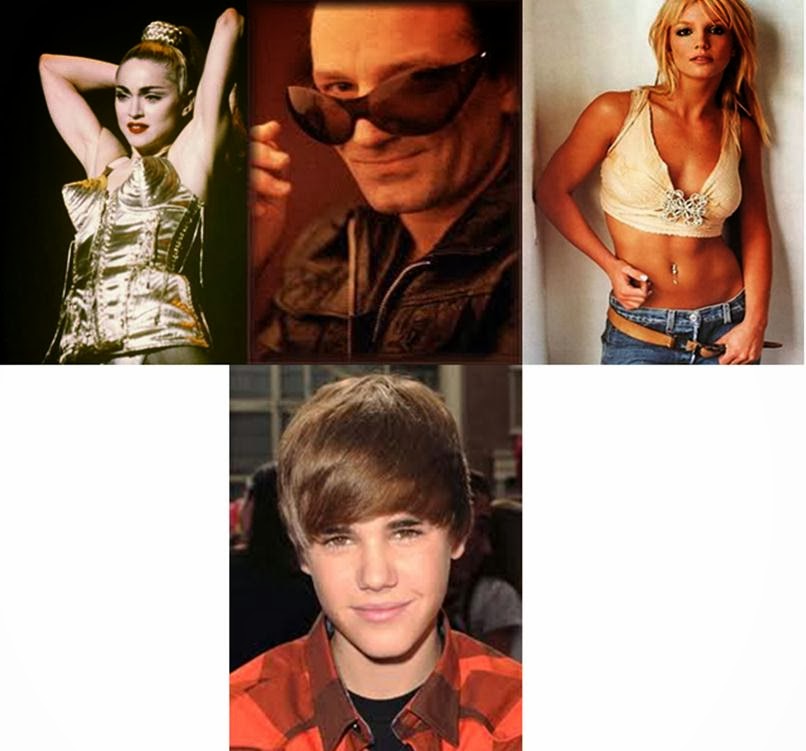
Stars are constructed, artificial images, even if they are represented as being "real people", experiencing real emotions etc. It helps if their image contains a USP — they can be copied and/or parodied because of it. Their representation may be metonymic — Madonna's conical bra in the early 1990s, Bono's 'Fly' sunglasses, Britney's belly, Justin Bieber's bangs. Pop stars have the advantage over film stars in that their constructed image may be much more consistent over a period of time, and is not dependent on the creative input of others.Ideology & Culture
Stars represent shared cultural values and attitudes, and promote a certain ideology. Audience interest in these values enhances their 'star quality', and it is through conveying beliefs ideas and opinions outside music that performers help create their star persona. A star may initiate a fashion trend, with legions of fans copying their hairstyle and clothing. Stars initiate or benefit from cultural discourse (e.g. via their Twitter feed), and create an ongoing critical commentary. Now more than ever before, social networks give pop stars the opportunity to establish their own values outside their music. Lady Gaga tweets frequently about LGBT issues, and expects her Little Monsters to engage with that discourse just as much as she expects them to listen to her music.Stardom, and star worship in general is a cultural value in itself. Ideologies drawn upon include materialism and sexuality. Whole sites of institutional support (eg radio & TV shows, magazines, websites) are devoted to star scrutiny, and it seems we can never get enough information. Stars also provide us with a focal point for our own cultural thinking — particularly to do with Youth & Sexuality.
Industry and Audience
Stars are manufactured by the music industry to serve a purpose — to make money out of audiences, who respond to various elements of a star persona by buying records and becoming fans. Stars are the cogs around which a plethora of record company gears find themselves turning. Record companies nurture and shape their stars — as the TV talent show processes have shown us. They tend to manufacture what they think audiences want, hence the 'photocopied' nature of many boy bands, teen bands etc.However, there are whole markets out there who are not convinced by the hype and don't want to spend their money on blandness.The record industry also has a duty to provide bands/artists who are perceived as 'real' (for 'real, maybe read 'ugly' or unpolished) for these audiences.Stars can also be created by this route. Pop stars, whatever their nature, are quite clearly the product of their record company — and they must be sold.Character & Personality
A star begins as a "real" human, possessing gender & race characteristics, and existing against a socio-historic background. The star transformation process turns them into a construct, but the construct has a foundation in the real.We tend to read them as not-entirely-fictional, as being are very much of their time and culture, the product of a particular generation. Stars provide audiences with a focus for ideas of 'what people are supposed to be like' (eg for women, thin/beautiful) - they may support hegemony by conforming to it (thin/beautiful) or providing difference (fat/still lovable).Much of the discussion of stars in celebrity magazines is about how stars compare to the current hegemonic ideal, and how we compare to the stars.ISL 6 - UK music magazine publications
Kerrang!
Kerrang! is a UK-based magazine devoted to rock music published by Bauer Media Group. It was first published on 6 June 1981 as a one-off supplement in the Sounds newspaper. Named after the onomatopoeic word that derives from the sound made when playing a power chord on a distorted electric guitar, Kerrang! was initially devoted to the New Wave of British Heavy Metal and the rise of hard rock acts. In the early 2000s it became the best-selling British music newspaper.http://kerrang.com/
This type of magazine has a very specific audience which is music lovers, typically the more heavy bands like bring me the horizon or bullet for my valentine. You can see this on there many magazine covers, for example:
Below is one of the magazine covers which Kerrang! publish. You can see that it is all based around the music industry, including stories and pictures of different kinds of bands as well as including posters of some bands or artists which they would usually include in the magazine. The graphology on this magazine is the main focus of the magazine as it is the best way to advertise the magazine by making it eye catching. That is why the colours are so bright and the text is also bright and bold, it is because it is trying to sell itself through just appearance.
This magazine cover includes genres like Metal-core, Punk rock, Rock, Pop punk, Hard rock, Etc. And that is only some of the ones on the front of the covers as the magazine includes others inside and on other issues.
Editor - James McMahon
Founder - Alan Lewis
Publisher - Bauer Media Group
Kerrang! also has a website, a Radio station and TV station as well.
http://radioplayer.kerrangradio.co.uk/
Subscribe to:
Posts (Atom)